

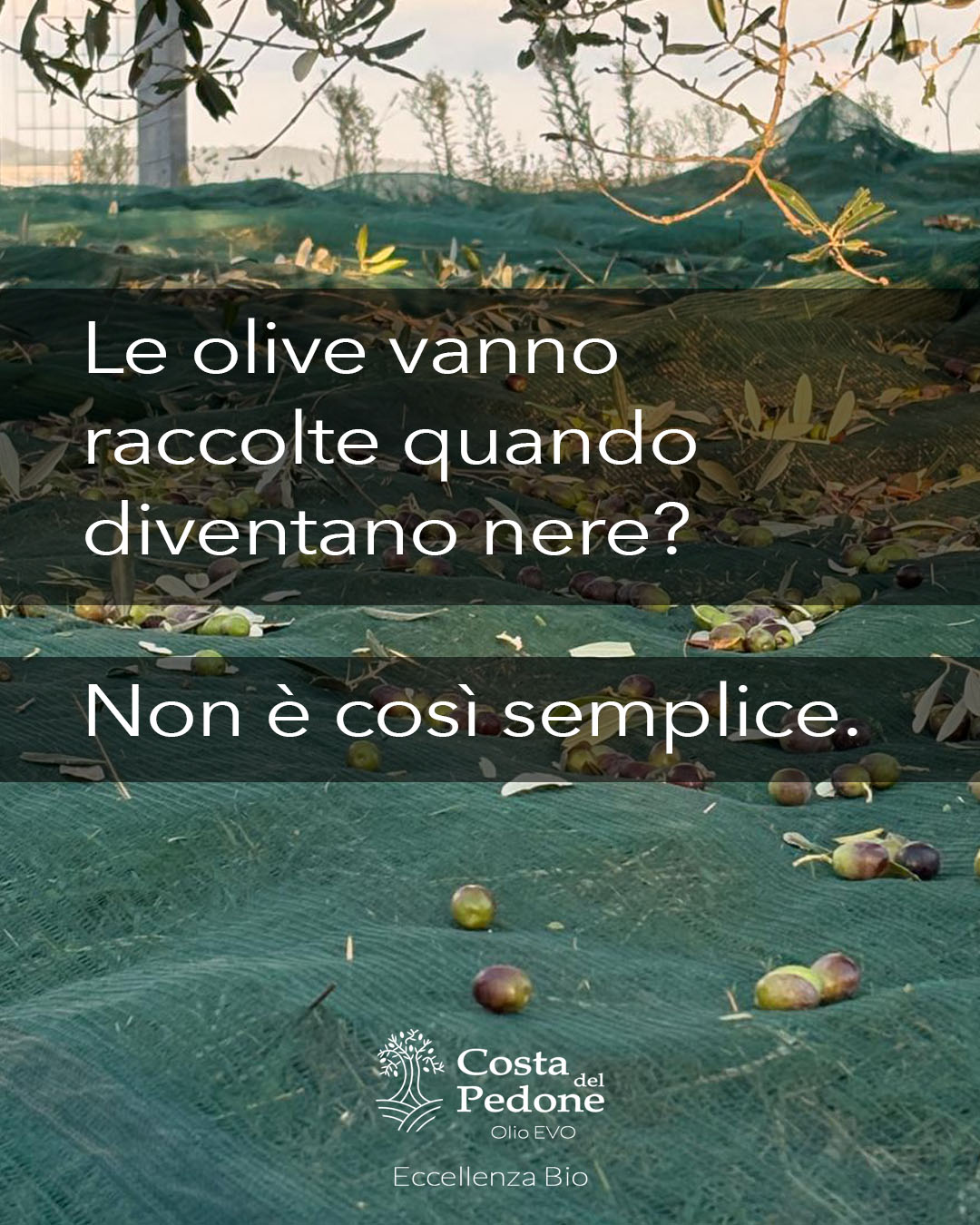
There is a time of year when olive groves slowly begin to change their appearance. Among the silvery leaves, the olives start to transform: from deep green to shades of purple, eventually reaching, in some cases, dark and intense tones. It is a sign that nature is completing another cycle.
But when should olives really be harvested? The answer is not as simple as it might seem. It is not enough to wait until they turn black, nor can we rely solely on the calendar.
The right harvest time is the result of observation, experience, and knowledge. It is a decision that can profoundly influence the characteristics of extra virgin olive oil and reflects the relationship between those who cultivate the land and the land itself.
Veraison: When Olives Begin to Change Color
During autumn, olives go through a phase known as veraison, the natural process through which the fruit gradually changes color.
It is one of the most visible signs of ripening, but it does not necessarily mean that the olives are ready to be harvested.
Veraison does not occur simultaneously in every fruit. Even on the same tree, green, purple, and darker olives may coexist. This depends on the variety, exposure to sunlight, and weather conditions.
Color, therefore, tells part of the story, but not the whole story.
To understand when to harvest, other factors must also be considered, because olive ripening is a complex processduring which both the composition of the fruit and the characteristics of the oil it can produce gradually change.
Harvest Early or Wait? A Choice That Changes the Oil
One of the most interesting aspects of olive harvesting concerns the relationship between quantity and quality.
As olives ripen, they accumulate oil, although this process does not continue indefinitely. A later harvest may, under certain conditions, result in a higher oil yield, but it does not necessarily guarantee a better product.
Olives harvested in the early stages of ripening can produce oils with a more intense character, pronounced vegetal aromas, and more noticeable bitterness and pungency.
As ripening progresses, the sensory profile may evolve towards different characteristics, sometimes becoming softer and more delicate.
This does not mean there is one universally correct choice. It means that different harvesting times can lead to different results.
For this reason, when producing high-quality EVO oil, deciding when to harvest is just as important as knowing how to cultivate the trees.
Every Olive Cultivar Has Its Own Rhythm
Not all olives ripen in the same way.
The cultivar, or olive variety, influences ripening times, the composition of the fruit, and the sensory profile of the oil.
In Tuscia, varieties such as Caninese, Frantoio, and Leccino represent different expressions of the region’s olive-growing heritage. Each has its own characteristics, requiring careful observation and specific decisions.
Seasonal conditions also play a fundamental role. Temperatures, rainfall, water availability, and the condition of the trees can all affect ripening times.
This is why there is no single harvest date that applies to every olive grove or every year.
Nature does not follow a predetermined calendar. Those who cultivate it must learn to interpret its signals.
Olive Harvesting in Tuscia: Between Land and Memory
In the countryside of Grotte di Castro, near Lake Bolsena, autumn brings a special atmosphere.
The light becomes softer, the days grow shorter, and olive groves become the center of an activity that brings together work, family, and tradition.
Here, in a landscape shaped by volcanic origins and deep historical roots, olive harvesting represents much more than a stage of agricultural production.
It is a moment of continuity between generations, when the experience of those who cultivated the land before us meets the knowledge and choices of today.
For a family-run agricultural business like Costa del Pedone, observing olive ripening also means preserving this connection: respecting nature’s timing while continuing to pursue quality.
Every season is different, and every harvest brings new decisions.
From Harvest Timing to the Quality of Organic Olive Oil
Choosing the right moment is only one part of the journey.
To produce organic extra virgin olive oil that fully expresses the characteristics of the olives, it is essential to pay attention to the stages that follow.
Careful handling during harvesting, proper management of the fruit, and prompt processing at the olive mill all help preserve its quality.
Even olives harvested at the ideal moment can lose some of their characteristics if they are stored for too long or under unsuitable conditions before milling.
Quality, therefore, does not come from a single decision, but from a series of conscious choices.
This vision reflects the philosophy of EVOlogy: recognizing olive oil not simply as food, but as the result of a respectful relationship with nature, the land, and time.
The Right Moment Is Not Just Seen: It Is Recognized
So, when should olives really be harvested?
When observing the fruit, understanding the cultivar, considering the season’s conditions, and identifying the desired characteristics of the oil all indicate that the time has come.
Not necessarily when every olive has turned black.
Harvesting is not simply a task to be carried out every autumn. It is a decision that embodies months of waiting and helps define the identity of the oil that will eventually reach our tables.
Among the olive trees of Tuscia, this moment continues to renew itself, season after season, keeping the connection between roots and future alive.
Because nature does not give us an exact date. It offers us signs to understand.
And the right moment comes from knowing how to read them.
🌿 Discover the world of Costa del Pedone and follow the story of the olive harvest, from the fruit still hanging on the branches to the organic extra virgin olive oil that preserves the flavors of our land.
