

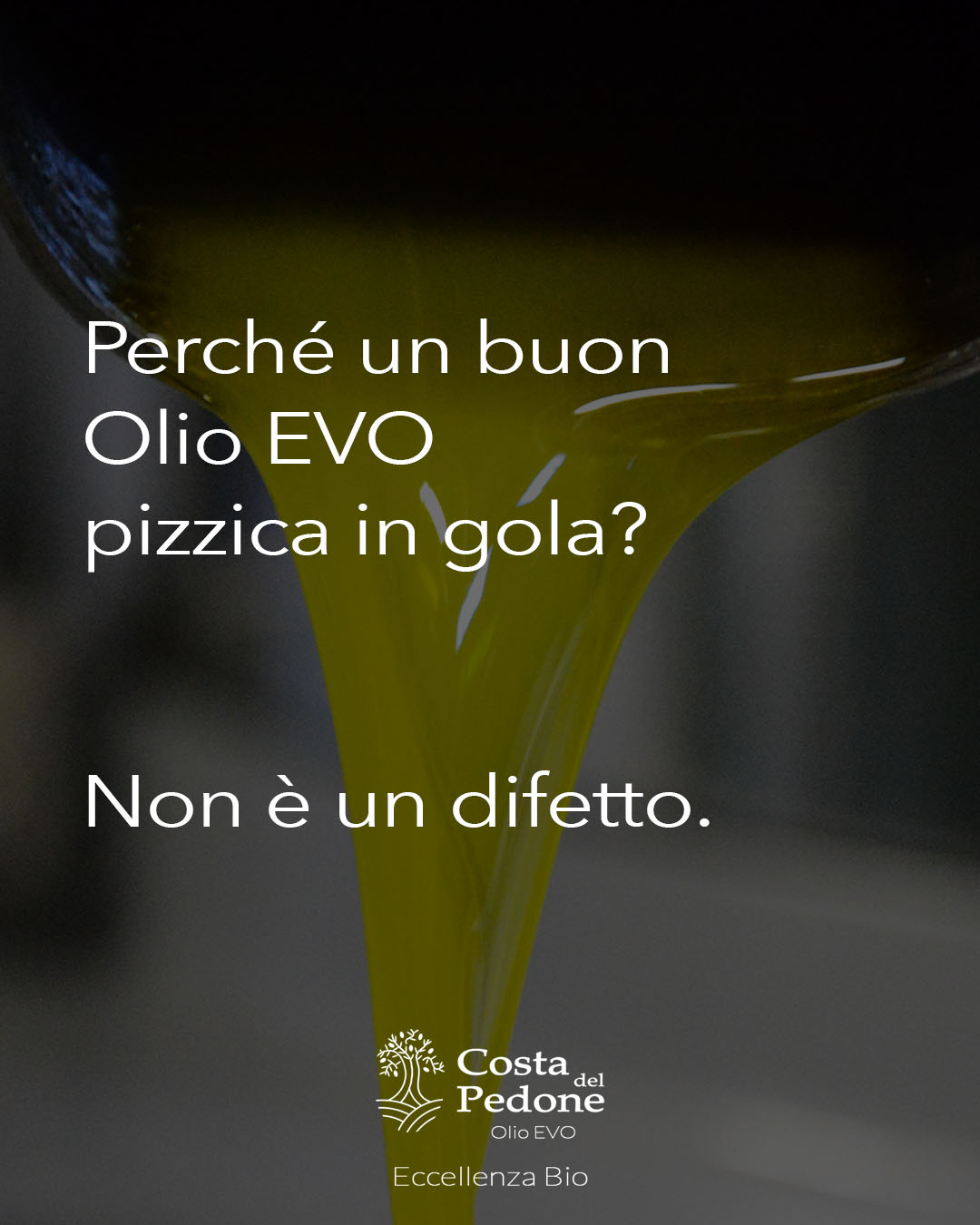
A drizzle of olive oil on bread, the first taste and, after just a few moments, that unmistakable sensation at the back of your throat. A slight peppery tickle that can become more intense in oils with a stronger character. For those who are not familiar with the world of extra virgin olive oil, the first reaction may be to consider it a flaw. In fact, quite often, the opposite is true.
Pungency is one of the positive characteristics that can be found in a quality EVO oil, and it tells us something about the olives, the moment they were harvested, and the presence of valuable natural compounds.
Understanding why good olive oil feels peppery in your throat therefore means learning how to read it through the senses.
That Peppery Sensation Is Not a Flaw
When tasting extra virgin olive oil, some sensations can be surprising. Bitterness and pungency, for example, are sometimes perceived negatively because we tend to associate quality with mildness.
In the world of EVO oil, however, both are considered positive attributes when they are present in a balanced way.
Pungency is a characteristic tactile sensation of olive oils and can be particularly noticeable in extra virgin olive oils produced from olives harvested while still green or at the beginning of the ripening process.
This is why an oil that leaves a pleasant peppery sensation should not automatically be considered too strong. On the contrary, that sensation can be one of the expressions of its personality.
The Connection Between Pungency and Polyphenols
There is also a natural explanation behind this characteristic. Extra virgin olive oil contains polyphenols, antioxidant compounds naturally found in olives.
One of the best-known compounds is oleocanthal, which is associated with the characteristic pungent sensation felt particularly at the back of the throat.
Polyphenols are also important because they contribute to the oil’s stability against oxidative processes. Their presence and concentration, however, can vary considerably depending on the olive cultivar, the degree of ripeness, the harvest year, and the methods used for processing and storage.
For this reason, pungency can be an interesting indicator, but it should not be interpreted as a simple equation: the more an oil makes your throat tingle, the better it necessarily is.
Quality is always about balance.
Bitterness, Pungency, and Fruitiness: Finding Harmony
A quality EVO oil reveals itself through a variety of sensations.
First comes the aroma, with its fruitiness and notes that may recall grass, leaves, artichoke, almond, or other vegetal elements. During tasting, bitterness then emerges, often followed by pungency.
There is no single ideal level of intensity for every olive oil. Different cultivars have different sensory profiles, and this diversity is one of the great treasures of Italian olive-growing culture.
What really matters is harmony: aromas, bitterness, and pungency should interact with one another, creating a coherent and recognizable sensory experience.
Tasting the Territory
In Tuscia, between Grotte di Castro and Lake Bolsena, olive trees grow in a landscape shaped by its volcanic origins and by an agricultural culture deeply rooted in history.
Every harvest brings different conditions. Temperatures change, rainfall varies, and olives ripen at different times. Nature changes and, inevitably, each oil expresses different nuances.
This natural variation reminds us that organic extra virgin olive oil is a living agricultural product, not something that should taste exactly the same every season.
Behind that peppery sensation in the throat may lie the cultivar, the choice of harvest time, and all the work required to take the olives from tree to mill while preserving their natural characteristics.
How to Recognize Pungency When Tasting Olive Oil
To experience this characteristic more clearly, try tasting the olive oil on its own.
A small amount is enough. After taking in its aroma, bring the oil into your mouth and gently distribute it across your palate. After a few seconds, as you swallow, the pungency may appear at the back of the mouth and in the throat.
Sometimes it is delicate. At other times, it arrives more decisively and may even trigger a slight cough.
You do not need to be a professional olive oil taster to begin recognizing these sensations. What matters most is curiosity and the willingness to dedicate a few extra seconds to a food we too often use without truly stopping to experience it.
That Peppery Sensation Tells Us More Than Flavor
Learning about olive oil means changing the way we experience it at the table.
That peppery sensation, which may initially be surprising, becomes part of a language made of aromas, sensations, and territory. A language that tells the story of the olives, the season, and the choices made by those who cultivated them.
This is also the meaning behind EVOlogy: rediscovering olive oil as part of everyday culture, learning to recognize its characteristics and making more conscious choices.
Because sometimes, a small sensation at the back of the throat is enough to reveal just how much complexity can be found in a single drop of olive oil.
🌿 Discover the world of Costa del Pedone and continue your journey into the culture of organic extra virgin olive oil.
